
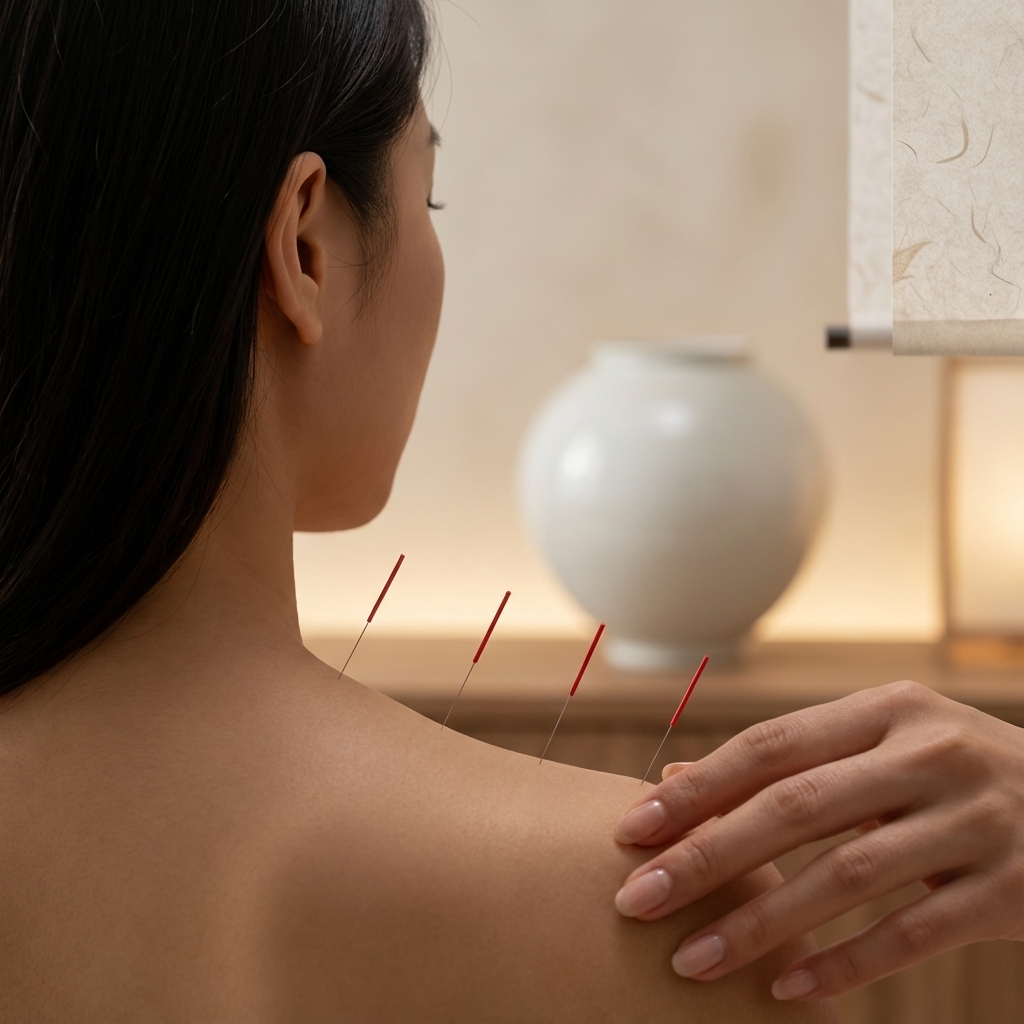
Forward Head Posture
Forward Head Posture
Turtle neck and straight neck, where the neck juts forward, causing stiffness in the back of the neck and shoulders

# Possibility / Realistic Goals (2)
Q I am a 38-year-old bank employee who has had forward head posture for 10 years. Honestly, I am curious: is it realistically possible to restore the original neck curve for a neck that has been like this for 10 years? Or is pain management the best option?
A. To be frank, restoring the complete C-shaped curve of a 10-year-old forward head posture is not easy. However, partial curve improvement and a pain-free daily life are sufficiently realistic goals. In many cases, alignment and function improve significantly if treatment, correction, and exercise are combined for more than 6 months.
View details →Q I am a 44-year-old logistics center manager with early-stage cervical disc herniation. The orthopedic doctor says that surgery might be necessary if the condition worsens, but is it possible to manage this with traditional Korean medicine treatments without surgery?
A. The general consensus in the medical community is that non-surgical treatment should be the priority for early-stage disc herniation without nerve paralysis or progressive muscle weakness. In many cases, the condition can be managed without surgery by reducing the burden on the disc through forward head posture correction and traditional Korean medicine treatments. However, if symptoms such as arm weakness or paralysis progress, a surgical evaluation is necessary.
View details →# Comorbidities (1)
# Lifestyle Management (2)
Q I am a 36-year-old developer in my third year of working from home. I have started treatment for straight neck syndrome, but how should I change my home desk environment to prevent recurrence?
A. Raise the top of the monitor so it is at eye level, and use a stand and an external keyboard for your laptop. The basic chair height should be such that your elbows are at a 90-degree angle and your feet touch the floor. A routine of standing up for 10 minutes to stretch your neck and chest after every 50 minutes of work is just as important as the treatment itself.
View details →Q I am a 42-year-old housewife looking to start exercising. There are so many exercises said to be good for forward head posture that I am confused. Please tell me just a few key exercises I can do at home every day.
A. There are three key points. ① Chin Tuck — Place the back of your head against a wall, pull your chin towards your neck, and hold for 10 seconds, 10 times. ② Chest Stretch — Place your arms against a doorframe and push your chest forward for 30 seconds. ③ Scapula Retraction — Bring both shoulder blades together towards the center of your back for 10 seconds, 10 times. 2 to 3 sets a day is sufficient.
View details →# Safety (1)
# Drug Combination / Interactions (1)
# Prognosis / Recovery (2)
Q I am a 28-year-old designer. I have been diagnosed with straight neck syndrome and am about to start treatment. How long does it usually take to see improvement? Is it possible to return to a full C-curve?
A. Pain and muscle tension usually improve significantly within 4 to 8 weeks of treatment. Structural recovery of the cervical curve takes longer, requiring consistent corrective therapy and exercise for at least 3 to 6 months; the younger and more flexible you are, the higher the chances of recovery. The prognosis is generally good for those in their 20s.
View details →Q I am a 48-year-old hair salon owner in Dongincheon. I’ve known I have "turtle neck" posture for about five years, but I neglected it because I was too busy. What happens if I leave it like this? I heard it could progress to a herniated disc; is that true?
A. It is true. Turtle neck posture increases the load on the cervical spine, which can accelerate disc degeneration. If left untreated, it increases the risk of progressing to a herniated disc (cervical disc herniation) or cervical stenosis. If you experience numbness in your arms or abnormal sensations in your hands, it is a sign of nerve compression, so you should seek medical attention immediately.
View details →# Causes Explained (2)
Q I am a 32-year-old office worker in Dong-gu, Incheon. I look at a monitor for 8 hours a day, and my neck is always stiff. I was told at the hospital that I have a straight neck. Does posture really change the shape of the neck bones?
A. Yes, it is possible. A normal cervical spine forms a C-shaped curve, but if you repeatedly lean your head forward for long periods, the curve straightens out, resulting in a straight neck. For every 1 cm the head moves forward, the load on the neck increases by 2 to 3 kg, causing chronic tension in the muscles and ligaments.
View details →Q I am a mother of a high school senior daughter preparing for college entrance exams. My daughter was diagnosed with "turtle neck" syndrome, and lately she has been complaining of frequent headaches. Can turtle neck syndrome actually cause headaches?
A. Yes, it is a common associated symptom. If the muscles at the back of the neck (such as the suboccipital muscles) become chronically tense due to turtle neck syndrome, it can lead to tension headaches or cervicogenic headaches. It is characterized by a pattern where the headache starts at the back of the head and spreads to the temples and around the eyes.
View details →# Food / Triggers (2)
Q I am a father of a middle school son. My child looks at his smartphone for 4 to 5 hours a day, and he already seems to have "turtle neck" syndrome. Is the smartphone really the main culprit? How many hours a day is considered acceptable?
A. Looking down at a smartphone is a major cause of turtle neck syndrome. Tilting your head down 60 degrees places a load of approximately 27 kg on the cervical spine. There is no safe time limit; posture (holding the phone at eye level) and taking breaks (stretching the neck every 30 minutes) are more important than the duration.
View details →Q I am a self-employed individual in my 50s. I feel fine during the day, but my neck feels stiffer when I wake up in the morning. I have a straight neck; could the pillow be the problem? I've heard that high pillows are bad; what kind of pillow should I use?
A. Yes, the pillow is a significant factor. High pillows fix the neck in a bent position while sleeping, worsening a straight neck. When lying on your back, a pillow that supports the cervical curve by about 6 to 8 cm is suitable, while when sleeping on your side, a shape that provides support at shoulder height is ideal.
View details →# Treatment Schedule (1)
# Treatment Stages (2)
Q I am a 33-year-old marketer diagnosed with forward head posture (turtle neck). I understand that Korean medicine clinics offer various treatments besides acupuncture, such as moxibustion, pharmacopuncture, and Chuna manual therapy. In what order do I receive these treatments? Do I receive them all from the start?
A. No, the treatment proceeds in stages depending on the condition. We usually start by releasing muscle tension with acupuncture and cupping. If hardened adhesions are confirmed, moxibustion is added, and if inflammation is evident, pharmacopuncture is added. Alignment issues are corrected with Chuna manual therapy, and for chronically weakened ligaments, fire acupuncture and thread embedding are considered. The treatment plan is designed after examinations during the initial consultation.
View details →Q I am a 51-year-old taxi driver who has been suffering from chronic straight neck syndrome for several years. I have tried regular acupuncture several times, but the relief is only temporary. I heard there is something called *Dochim*; would it be suitable for my case?
A. Chronic cases where regular acupuncture only provides temporary relief are excellent indications for *Dochim*. *Dochim* is an acupuncture needle with a fine blade-like tip. It directly separates fascia and ligaments that have hardened and adhered over time, releasing structural stiffness that regular needles cannot reach. The decision to apply it is made after confirming the areas of adhesion during an examination.
View details →# Effectiveness (2)
Q I am a programmer in my 40s. I have a straight neck, and my shoulders are always stiff like rocks. Is acupuncture really effective? Even when I get massages, my neck stiffens up again after a day or two.
A. Acupuncture treatment goes beyond temporary relaxation to directly release deep muscle tension patterns and trigger points. Because it can stimulate the deep layers of the suboccipital and levator scapulae muscles that are inaccessible to surface massage, studies have reported significant improvements in neck and neck pain.
View details →Q I am a 35-year-old housewife who takes Pilates classes. I heard that Chuna manual therapy is good for correcting forward head posture, but is stretching or exercise alone insufficient? I am curious about the difference between Chuna and other methods.
A. Exercise and stretching are active management methods for building muscle strength and flexibility, while Chuna is a manual therapy that directly corrects the alignment of misaligned cervical and thoracic vertebrae and improves joint mobility. Since the effectiveness of exercise is limited when joints are misaligned, combining the two yields the best results.
View details →Forward Head Posture is not just a simple symptom
Korean medicine that considers both your constitution and lifestyle rhythm treats the root cause.
From consultation to precise treatment, we provide personalized care.
Prescriptions tailored to your constitution and symptoms treat the root cause
The director personally sees you from first to follow-up visits
We identify the essence through Sasang constitution, pulse and abdominal diagnosis
Treatment based on long clinical experience and evidence
Was this helpful? If you need accurate care for your condition, please contact us below.