
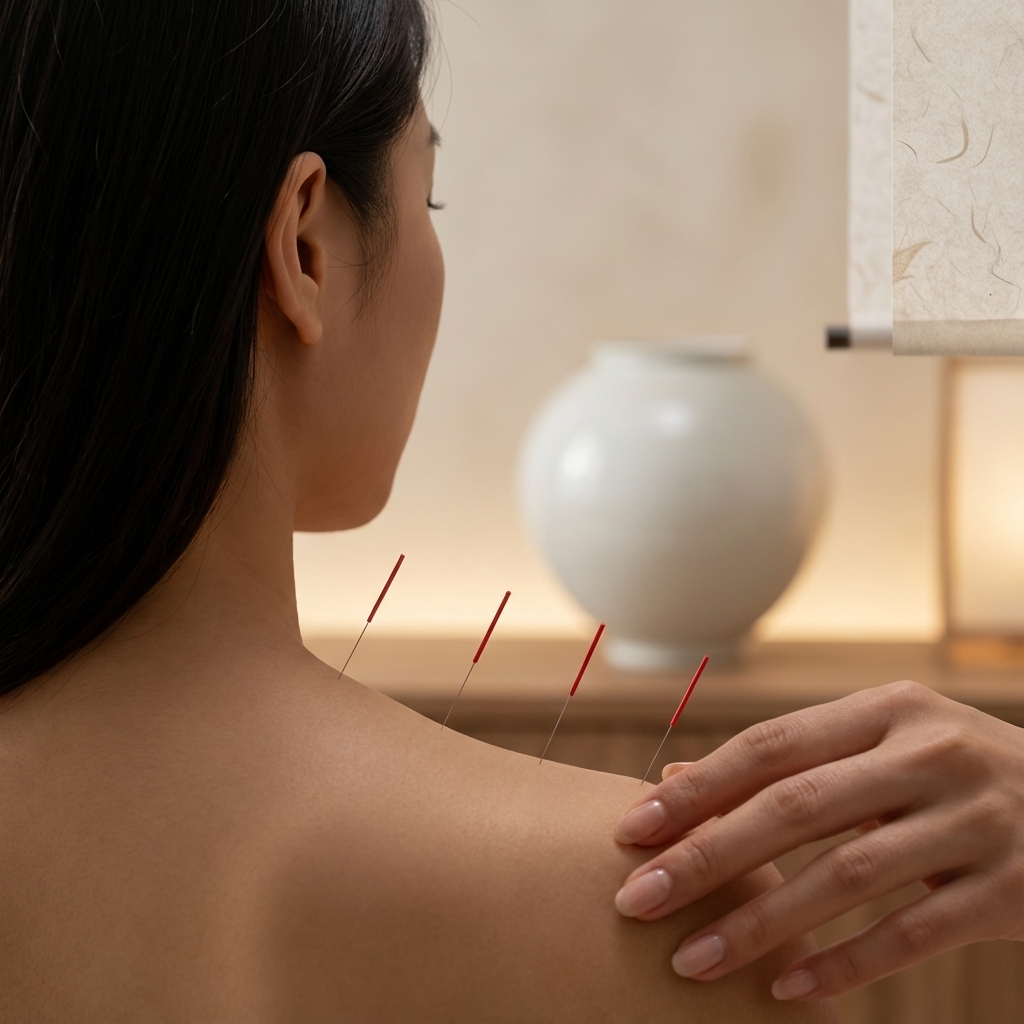
Sacroiliac Joint Pain
Sacroiliac Joint Pain
Stiffness on one side of the buttocks and pelvis, and sharp sacroiliac joint pain when sitting down and standing up

# Possibility / Realistic Goals (1)
# Comorbidities (1)
# Lifestyle Management (2)
Q What can I do to manage sacroiliac joint pain at home?
A. Avoid crossing your legs or standing with uneven weight distribution, and sit in a balanced posture. Strengthening your gluteal and core muscles, along with applying warm compresses, is helpful, and it is best to avoid sofas that are too soft.
View details →Q I'm curious about which exercises are good and which should be avoided for sacroiliac joint pain.
A. Exercises that stabilize the glutes and core are beneficial, while twisting movements to one side, deep squats, and strenuous lunges should be avoided during the acute phase. The principle is to gradually strengthen within a pain-free range.
View details →# Safety (2)
Q Is it dangerous to insert needles or fine blades into the buttocks?
A. It is safe because the procedure is performed while confirming the location and depth using ultrasound. Around the sacroiliac joint, the needle targets ligaments and soft tissues, avoiding major nerves and blood vessels; mild bruising and stiffness after the procedure subside within a few days.
View details →Q Are there any warning signs that indicate I absolutely need a detailed examination for my sacral pain?
A. If morning stiffness lasts for more than an hour, does not improve with rest and worsens at night, causes pain in both buttocks alternately, or is accompanied by fever, weight loss, or leg numbness, other diseases such as ankylosing spondylitis or infection must be differentiated.
View details →# Drug Combination / Interactions (2)
Q Can I receive bee venom acupuncture and pharmacopuncture treatments while taking anti-inflammatory painkillers?
A. In most cases, they can be combined. However, if you have an allergy to bee venom (bee acupuncture) or are taking anticoagulants or anticoagulants, please inform us in advance so that we can safely adjust the dosage and procedures.
View details →Q I recently received a steroid injection in my buttocks. Is it okay to receive Oriental medicine treatment immediately afterward?
A. It is safe to allow a gap between treatments on the same area immediately after an injection. Treatment to strengthen the ligaments usually begins after about 1 to 2 weeks, once inflammation has subsided.
View details →# Prognosis / Recovery (2)
Q How long does it take for sacroiliac joint pain to improve after treatment?
A. Acute cases improve within a few weeks, while chronic cases usually improve gradually over 4 to 8 weeks or more. Since ligament strengthening takes time, the joint is stabilized over multiple sessions rather than recovering all at once.
View details →Q It gets better, but then flares up again if I overexert myself. How can I reduce the risk of recurrence?
A. It is easy to recur if you overexert yourself before weakened ligaments are sufficiently strengthened. Recurrence is significantly reduced if you complete ligament strengthening treatment and combine it with hip and core muscle strengthening and posture management.
View details →# Causes Explained (1)
# Food / Triggers (2)
Q In which postures or movements does sacroiliac joint pain worsen?
A. It worsens when sitting down and standing up, turning over in bed, standing on one leg or sitting with legs crossed, and going up and down stairs. An unbalanced posture makes the joint more unstable.
View details →Q My buttocks on one side have been hurting continuously since childbirth. Could it be due to the sacroiliac joint?
A. During pregnancy and childbirth, pelvic ligaments loosen due to hormonal influences, causing instability in the sacroiliac joint and commonly resulting in pain. If pain on one side of the buttocks persists for a long time after delivery, sacroiliac joint pain should be suspected.
View details →# Treatment Schedule (2)
Q I live in Dong-gu, Incheon. How is the treatment for sacroiliac joint pain conducted on my first visit?
A. We confirm whether the sacroiliac joint is the cause through a physical examination, and after assessing the condition of ligaments and adhesions using ultrasound, we determine a treatment plan, such as pharmacopuncture or moxibustion. In many cases, the examination and the first procedure are performed together during the initial visit.
View details →Q How often should I receive treatment? What if I can't come often?
A. In the early stages, about twice a week is ideal, but if it is difficult to visit frequently, the interval between visits can be extended by adding continuous stimulation using thread lifting.
View details →# Treatment Stages (1)
# Effectiveness (2)
Q When I get injections in my hip at an orthopedic clinic, the relief is only temporary, and the pain returns. Can Korean traditional medicine address this differently?
A. While injections quickly reduce inflammation, the weakened ligaments that caused joint instability remain, making recurrence likely. By strengthening the weakened ligaments themselves, we can aim for a state where the pain does not return.
View details →Q The MRI says my discs are fine, but my buttocks continue to hurt. Can pain that doesn't show up on tests also improve?
A. Sacroiliac joint pain is often not clearly visible on imaging, so it is easy to hear that there is "no abnormality." However, significant improvement is possible if pain is confirmed through physical examination by directly stimulating the joint and then treated.
View details →Sacroiliac Joint Pain is not just a simple symptom
Korean medicine that considers both your constitution and lifestyle rhythm treats the root cause.
From consultation to precise treatment, we provide personalized care.
Prescriptions tailored to your constitution and symptoms treat the root cause
The director personally sees you from first to follow-up visits
We identify the essence through Sasang constitution, pulse and abdominal diagnosis
Treatment based on long clinical experience and evidence
Was this helpful? If you need accurate care for your condition, please contact us below.