
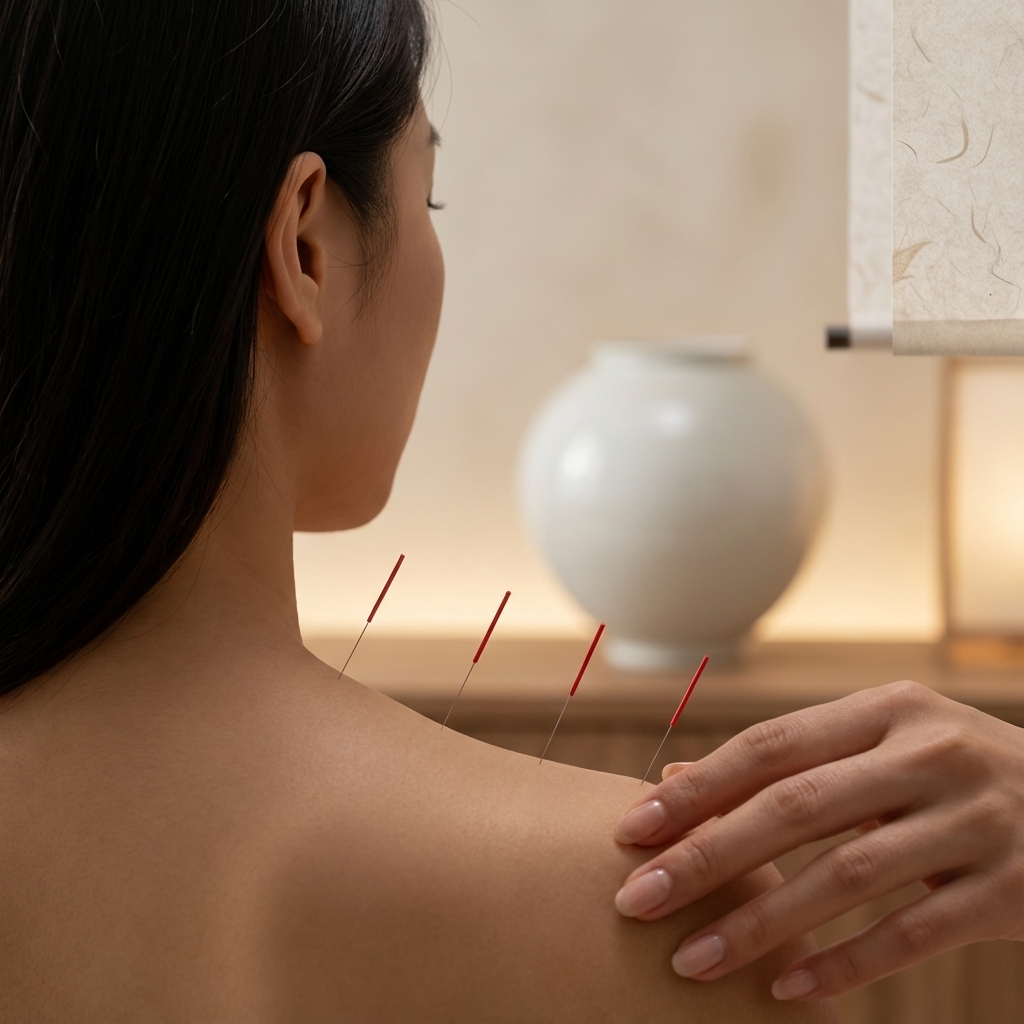
Q I am a 47-year-old male self-employed individual. I thought that treating lower back pain at a Korean medicine clinic was simply about getting acupuncture. What are the differences between moxibustion, thread embedding, and pharmacopuncture, and in what order are they administered?
A Acupuncture plays a different role: moxibustion promotes the circulation of Qi and blood and relieves muscle tension; moxibustion releases hardened adhesions and stimulates ligaments; fire acupuncture and thread embedding promote tissue regeneration; and bee venom acupuncture and pharmacopuncture have anti-inflammatory effects. Treatment typically begins with acupuncture, and necessary procedures are added step-by-step based on the patient's response, while the tissue condition is monitored via ultrasound.
Detailed Answer
The lesions of chronic lower back pain are not monolithic. Since muscle tension, trigger points, myofascial adhesions, ligament laxity, and residual inflammation are mixed in varying proportions for each patient, it is more reasonable to combine tools tailored to the specific lesion rather than performing a single procedure. General acupuncture is strong in relieving muscle tension and controlling pain; sharp needles (needle blades) are effective in releasing hardened adhesions and stimulating ligament attachment sites through micro-incisions; fire acupuncture and thread embedding are effective in inducing collagen regeneration and tissue strengthening through heat and foreign body stimulation; and bee venom and pharmacopuncture are strong in the anti-inflammatory effects of pharmacological components. This classification of stages aligns with the differential diagnosis of Korean medicine. Mild stages characterized by stagnation of Qi and blood can be resolved simply by circulating Qi and blood in the lumbar meridians with acupuncture; however, chronic lumbago caused by blood stasis hardening in deep blood vessels must be directly broken down with sharp needles; and kidney deficiency lumbago, where ligaments are stretched due to weak kidney energy and the lower back cannot support the condition, requires reinforcement through fire acupuncture and thread embedding to induce regeneration. At Dongjedang, we determine the stages by visually confirming via ultrasound which areas have hardened and which have stretched; therefore, the sequence of acupuncture—from needle acupuncture to moxibustion, to fire acupuncture/thread thread embedding, and finally to bee venom/pharmacopuncture—is combined differently for each patient. Furthermore, underlying all stages is internal treatment, specifically herbal medicine tailored to the patient's constitution to clear out blood stasis, dampness, and toxins while nourishing the liver and kidneys. This is because the internal state must be corrected while the external state is being treated to prevent the repaired areas from collapsing again.
Related FAQs
-
Q
I am a 58-year-old male. I have been advised to have spinal surgery, but I am scared and hesitant. In what cases is it possible to manage the condition with Korean medicine treatment without surgery?
#Possibility / Realistic Goals
-
Q
I am a 67-year-old woman who has had back pain for 20 years. At this age, can such long-standing pain be treated and improved? Is it too late?
#Possibility / Realistic Goals
-
Q
I am a 45-year-old female academy instructor. I have chronic lower back pain and numbness in my legs. As the pain has persisted, I have also developed depression and insomnia. Do you address these issues as well?
#Comorbidities
-
Q
I am a 52-year-old male civil servant. There is conflicting information regarding whether walking or swimming is good for the back; what exercise is actually helpful for chronic lower back pain?
#Lifestyle Management
-
Q
I am a 40-year-old female nurse. My lower back hurts the most when I wake up. Do sleeping positions or mattresses affect chronic lower back pain? How should I sleep?
#Lifestyle Management