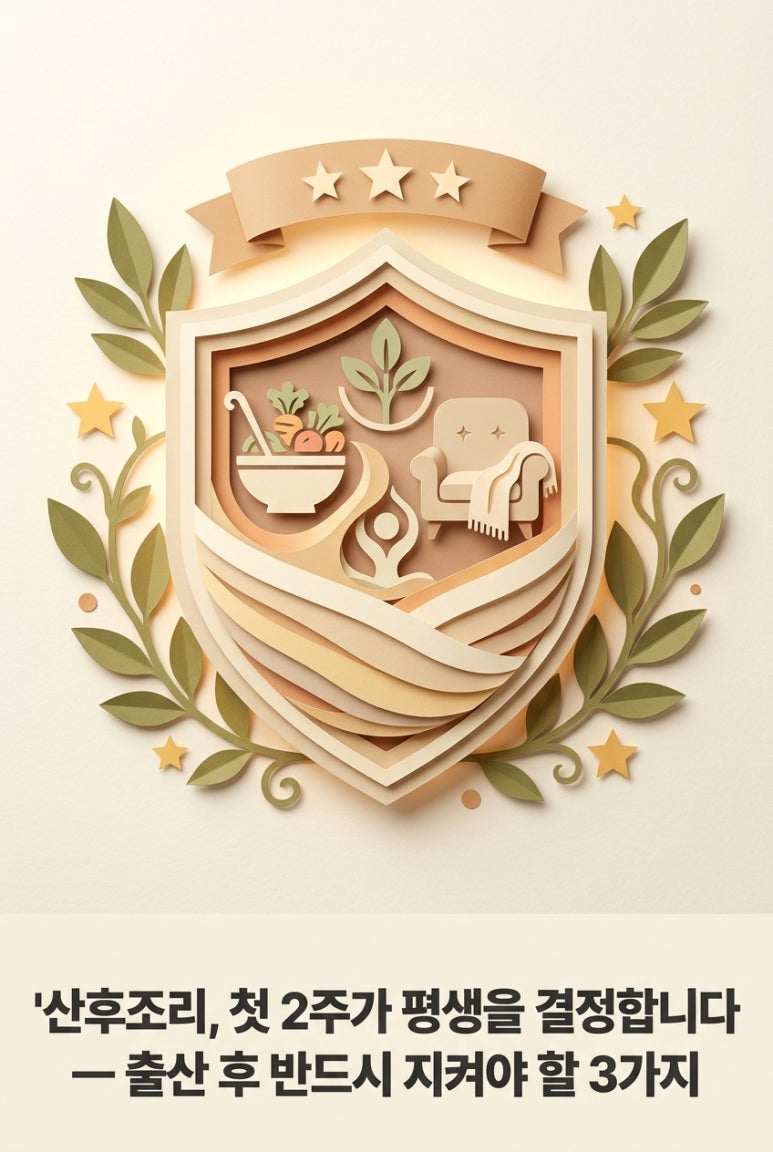
Postpartum Care: The First 2 Weeks Determine Your Lifetime Health — 3 Essential Rules You Must Follow After Delivery
 🧾 Answer First | Key Conclusion
After giving birth, your entire body aches, your wrists feel numb, and you're sweating profusely.
You're overwhelmed with anxiety: "Is this normal?"
The golden window for postpartum care is exactly 2 weeks after delivery.
How you spend this time determines whether you'll recover healthily without postpartum syndrome,
or suffer from years of cold sensitivity and joint pain.
Just follow these 3 things I'm about to share.
The rest will follow naturally as your body heals.
 ✅ Action | Immediate Implementation
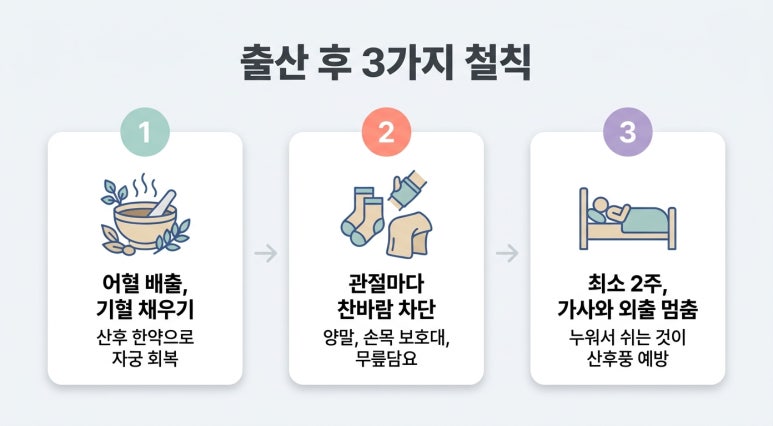
1️⃣ Remove Blood Stasis with Postpartum Herbal Medicine and Replenish Qi and Blood
Blood stasis forms in your body during delivery.
If this stasis remains, blood circulation becomes poor, slowing uterine recovery and causing widespread heaviness and pain.
Postpartum herbal medicine removes this stasis and replenishes the depleted qi and blood.
It's best to consult with a Korean medicine clinic within 1 week of delivery.
Lochia discharge accelerates, and uterine contraction recovery becomes noticeably faster[3].
2️⃣ Block Cold Wind at Every Joint — Heat Management
Wrists, ankles, knees, lower back.
After delivery, all these joints are in an open state.
Once cold air enters these areas, it's extremely difficult to remove it later.
Don't wash dishes with cold water.
Avoid direct air conditioner wind exposure.
Socks, wrist guards, and knee blankets — don't remove these three items for 2 weeks.
3️⃣ Rest for at Least 2 Weeks — Stop Housework and Going Out
"I'm feeling a bit better, so doing dishes should be fine."
This thought is where postpartum syndrome begins.
After delivery, your pelvis and ligaments haven't yet returned to their proper position.
If you overexert yourself in this state, your joints become misaligned and set permanently.
For 2 weeks, resting in bed is itself treatment.
Leave housework to family members and postpone outings for after 2 weeks.
If you try managing on your own and feel your recovery is slow, I'll create a prescription tailored to your constitution and condition.
 🚨 Warning | Critical Signs You Must Check
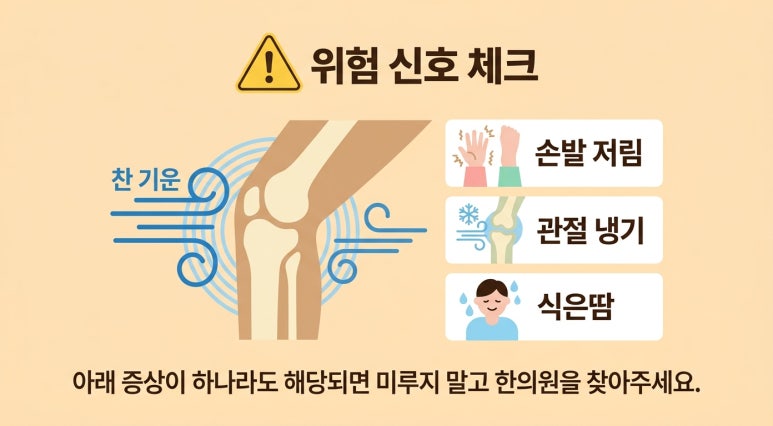
If any of the following symptoms apply, don't delay and visit a Korean medicine clinic.
✔ Numbness in hands and feet persists even 2 weeks after delivery
This means qi and blood aren't circulating to the extremities.
It's the most common first sign of postpartum syndrome.
✔ You feel cold wind seeping into joints
Cold has already begun settling inside your joints.
The sooner you remove it, the better the prognosis.
✔ You have cold sweats at rest and tire easily with slight movement
This signals severe qi and blood depletion.
Rest alone is insufficient; supplementation is needed.
✔ Lochia continues beyond 3 weeks or has developed a strong odor
This means uterine recovery is not proceeding properly.
Immediate professional consultation is necessary.
 🧠 The Why | Root Cause Analysis
Delivery is like having just completed a full marathon.
Your entire body's energy is depleted, and all muscles and joints are completely relaxed.
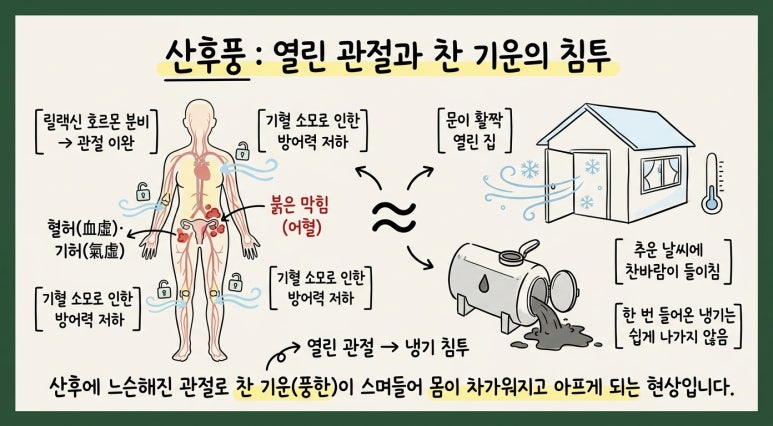
In Korean medicine, this state is called 'blood deficiency (血虛) and qi deficiency (氣虛)'.
A state where blood and vital energy have significantly depleted.
At this point, your body lacks the strength to protect itself.
This is where problems arise.
After delivery, joints and ligaments are loosened because of the hormone relaxin[2].
Imagine a house with its doors wide open.
When cold wind enters, the house quickly becomes cold, and once cold air enters, it doesn't easily escape even after you close the door.
This is postpartum syndrome.
Cold air enters the open joints and becomes established.
On top of this, blood stasis compounds the problem.
Blood stasis created during the delivery process remains in blood vessels, obstructing circulation.
The uterus recovers slowly, and the entire body feels heavy and sore.
That's why the core of postpartum care has two components.
Remove blood stasis and replenish qi and blood — while blocking cold air from entering.
After delivery, the relaxin hormone remains in the body for several weeks, maintaining joints and ligaments in a relaxed state[2].
During this period, excessive activity or cold exposure increases the risk of joint damage.
Postpartum, qi and blood are greatly deficient with open pores, making it easy for pathogenic cold and wind to invade.
If not treated promptly, this develops into postpartum syndrome and becomes chronic pain[3].
📊 Proof | Case Studies and Evidence
In its 2022 recommendations, the WHO stated that management in the first 6 weeks postpartum determines the long-term health of the mother[1].
It particularly emphasizes rest and appropriate medical intervention in the 2 weeks immediately after delivery.
According to the Korean Association of Oriental Obstetrics and Gynecology Clinical Practice Guidelines (2021), mothers receiving postpartum herbal medicine showed significantly higher uterine contraction recovery rates compared to non-recipients, and the lochia discharge period was shortened[3].
This is a case from my clinical practice.
A mother in her 30s came in 3 weeks after delivery with pain in both wrists and knees.
She had started housework immediately after leaving the postpartum care center.
I prescribed postpartum tonics tailored to her constitution for 4 weeks combined with acupuncture treatment, and her pain resolved within 6 weeks.
 🔚 Closing | Summary and Encouragement
To summarize, these are the three things.
Use herbal medicine to remove blood stasis and replenish qi and blood.
Keep your joints warm.
Think of these 2 weeks of rest as treatment itself.
Your body has accomplished something significant through delivery.
Now is the time for proper rest.
You don't have to endure this alone.
If you have questions about postpartum care tailored to your constitution and condition, feel free to contact us.
✍️ Reviewed by Director Choi Jang-hyuk, Dongjedang Korean Medicine Clinic
❓ FAQ
Q. Can I take postpartum herbal medicine while breastfeeding?
Yes, you can take it while breastfeeding.
Your Korean medicine doctor will remove prohibited ingredients from the prescription considering your breastfeeding situation.
Only trace amounts of herbal components pass into breast milk, and in fact, faster recovery of the mother's qi and blood improves milk quality.
If you notice changes in your baby's feeding amount or stools after taking it, inform your Korean medicine doctor immediately.
Q. How long exactly is the postpartum care period needed?
Absolute rest for at least 2 weeks and avoiding strenuous activity up to 6 weeks is the basic guideline.
The WHO also defines the first 6 weeks postpartum as the postpartum period and emphasizes management during this time[1].
Recovery speed varies depending on constitution and delivery method (vaginal/cesarean), so receiving individual consultation is most accurate.
Q. I already have postpartum syndrome symptoms. Can treatment help even now?
Yes, it can.
If treatment for postpartum syndrome begins within 3 months of onset, most cases show good outcomes[4].
However, the longer you wait, the deeper the cold becomes established, extending treatment duration.
Right now, when you feel the symptoms, is the fastest time to start.
📚 References
[Western Medicine (WM)]
[1] WHO (2022). "WHO recommendations on postnatal care of the mother and newborn"
[2] ACOG (2018, reaffirmed 2021). "Optimizing Postpartum Care" — Committee Opinion No. 736
[Korean Medicine (KM)]
[3] Korean Association of Oriental Obstetrics and Gynecology (2021). "Korean Medicine Clinical Practice Guidelines for Postpartum Disease"
[4] NIKOM (2020). "Systematic Review of Korean Medicine Treatment Efficacy for Postpartum Syndrome"
[5] Journal of Korean Medicine (2019). "Impact of Postpartum Tonics on Maternal Recovery"
Women's Health
Postpartum Care: The First 2 Weeks Determine Your Lifetime Health — 3 Essential Rules You Must Follow After Delivery
View Program