

Practical Ways to Manage Chronic Cystitis Without Antibiotics

 🧾 Answer First | Key Conclusion
When you take antibiotics at the hospital, you get better in a few days.
But then, a month or two later, it starts again.
That stinging sensation when urinating, going to the bathroom more than ten times a day.
You've probably worried, "Will I have to rely on antibiotics my whole life?"
Antibiotics are like a fire truck extinguishing an urgent fire.
If the building structure is flawed, it will catch fire again with the next blaze.
The real cause of recurrent relapse is not the infection itself, but the loss of the bladder's ability to protect itself.
Try the 3 routines I'm about to share with you for just 2 weeks consistently.
It will be your first step out of the vicious cycle of relying solely on antibiotics.
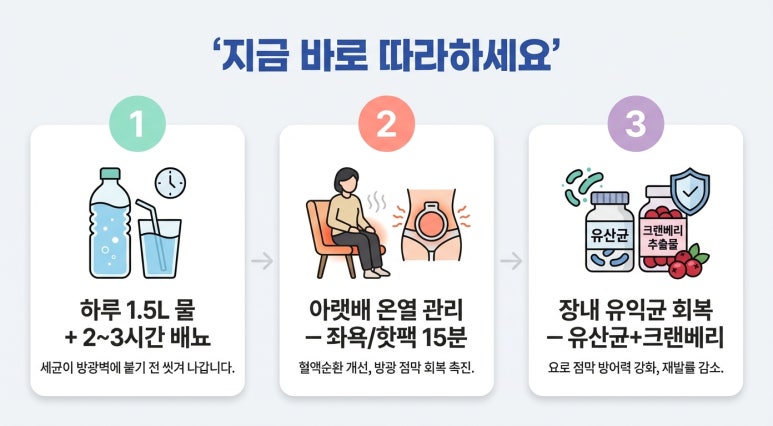 ✅ Action | Immediate Implementation
1️⃣ 1.5L of water daily + Urination every 2-3 hours
When you drink too little water, urine becomes concentrated and bacteria stay in the bladder longer.
When you drink enough water and urinate regularly, bacteria are washed away before they can attach to the bladder wall.
Aim for 1.5L per day (about 8 paper cups), and drink it in intervals of 30 minutes rather than all at once.
If you have a habit of holding urine, simply visiting the bathroom every 2-3 hours can significantly reduce the risk of recurrence.
2️⃣ Lower abdominal heat management — Sitz bath or heat pad for 15 minutes
Patients with chronic cystitis often have a cold lower abdomen.
In traditional Korean medicine, this is seen as 'insufficient yang energy in the lower abdomen area.'
Soak in warm water (38-40 degrees) for 10-15 minutes, or place a heat pad on your lower abdomen.
As blood circulation improves, the recovery speed of the bladder mucosa accelerates.
Doing this before bedtime also helps improve residual urine sensation and nocturia.
3️⃣ Recovery of beneficial gut bacteria — Probiotics + Cranberry extract
When antibiotics are taken repeatedly, it's not just the bad bacteria causing cystitis that die.
Beneficial bacteria living in the intestines and vagina also disappear together.
This breaks down the primary defense line protecting the urinary tract.
Consistently supplement with probiotics (especially Lactobacillus species), and
take cranberry extract (PAC 36mg or more/day) together
to reduce bacteria from attaching to the bladder wall[2].
Concentrated extract form is more effective than juice.
If you see no improvement trying on your own, consulting with a professional to identify the root cause is the quickest path forward.
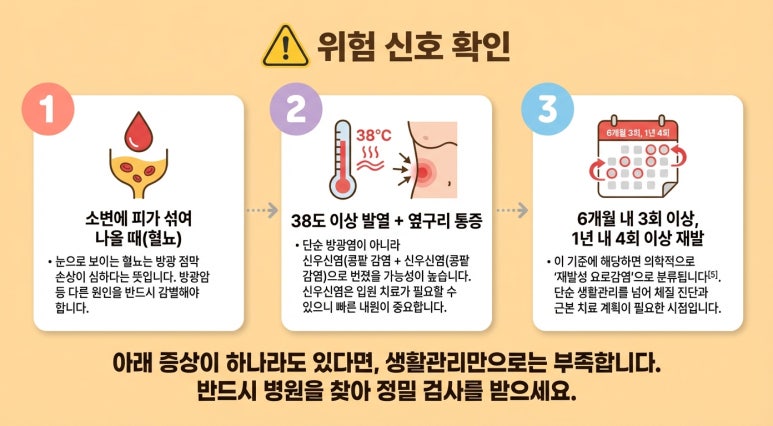 🚨 Warning | Warning Signs You Must Check
If you have even one of the following symptoms, lifestyle management alone is insufficient.
You must visit a hospital and receive detailed examinations.
✔ Blood in urine (hematuria)
Visible hematuria means the bladder mucosa is severely damaged.
Other causes such as bladder cancer must be ruled out.
✔ Fever of 38 degrees or higher + Flank pain
It is likely that simple cystitis has progressed to pyelonephritis (kidney infection).
Pyelonephritis may require hospitalization, so prompt medical attention is important.
✔ 3 or more recurrences within 6 months, or 4 or more within 1 year
If you meet this criteria, it is medically classified as 'recurrent urinary tract infection'[5].
It is time to move beyond simple lifestyle management to constitutional diagnosis and comprehensive treatment planning.
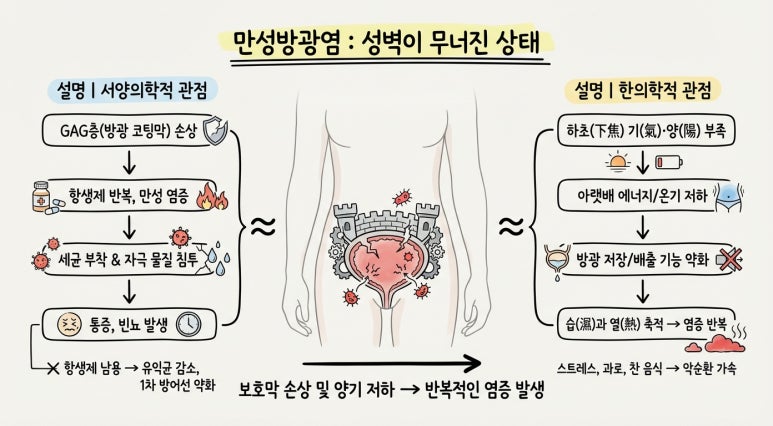 🧠 The Why | Root Cause Analysis
Think of the bladder mucosa as a fortress wall.
Antibiotics are an army eliminating the enemy forces (bacteria) that have entered the fortress.
If the fortress wall itself is crumbling, when the army leaves and the next enemy arrives, it breaches again.
Most people with recurrent chronic cystitis have this 'fortress wall' in a collapsed state.
Inside the bladder is a thin protective layer called the GAG layer.
You can think of it as a coating.
When this coating becomes thin due to repeated antibiotic use, chronic inflammation, hormonal changes, etc., bacteria easily attach to the bladder wall.
When irritating substances in urine directly touch the mucosa, pain and urinary frequency occur.
Repeated antibiotic use also reduces beneficial bacteria in the intestines and vagina, weakening the primary defense line protecting the urinary tract[1][5].
The qi (气) and yang (阳) of the lower burner (下焦) are deficient.
In simple terms, the energy and warmth in the lower abdomen have diminished.
When qi is deficient, the bladder's function of properly storing and expelling urine becomes weak.
When yang is deficient, dampness (濕) and heat (熱) accumulate below, causing inflammation to recur.
Stress, sleep deprivation, overwork, and habits of eating cold foods accelerate this process.
Antibiotics control the acute infection,
but the cycle of recurrence is only broken when you simultaneously rebuild the fortress wall (mucosa) and strengthen the garrison troops (immunity and beneficial bacteria).
📊 Proof | Cases and Evidence
The European Association of Urology (EAU) 2024 guidelines recommend that patients with recurrent urinary tract infections
try non-antibiotic strategies before antibiotic prophylaxis[1].
These include adequate fluid intake, cranberry products, probiotic supplementation, and intravaginal estrogen (for postmenopausal women).
In a 2023 Cochrane systematic review, the group taking cranberry products had approximately 26% lower recurrence rates of urinary tract infection compared to the placebo group[2].
The effect was particularly pronounced in women with repeated recurrences.
Let me share one case I've observed in clinical practice.
A woman in her 30s who works as an office employee came in with bladder inflammation recurring more than 5 times a year.
She took antibiotics each time, but the pattern was that symptoms would restart after a month or two.
While strengthening the qi of the lower burner with herbal medicine and improving pelvic blood flow with acupuncture,
we also established routines for fluid intake, urination habits, and heat management.
From the third month of treatment, there were no recurrences for 6 months,
and afterward, she has maintained a stable state with only check-up treatments every 2-3 months.
 🔚 Closing | Summary and Encouragement
To summarize again, here's what it comes down to:
First, drink plenty of water and urinate regularly.
Second, keep your lower abdomen warm.
Third, replenish your body's defenses with probiotics and cranberry.
Antibiotics are not bad.
However, antibiotics alone are simply not enough.
You can only escape this vicious cycle by simultaneously strengthening the bladder's own healing power.
You don't have to bear the inconvenience you're currently experiencing alone.
If you'd like a consultation where we can examine your constitution and lifestyle habits together, please feel free to contact us anytime.
✍️ Reviewed by Director Choi Jang-hyuk, Dongjeda Korean Medicine Clinic
❓ FAQ
Q. Is cranberry really effective for chronic cystitis?
Yes, it is effective.
The 2023 Cochrane review confirmed evidence that cranberry products reduce recurrence rates by approximately 26%[2].
However, concentrated extract containing PAC (proanthocyanidin) of 36mg or more is more effective than juice.
Rather than taking it alone, it's easier to feel the effects when combined with fluid intake and probiotics.
Q. How does treatment for cystitis work at a Korean medicine clinic?
In Korean medicine, recurrent relapse of cystitis is seen as 'qi deficiency of the lower burner (下焦 氣虛)' or 'accumulation of damp-heat in the lower area (濕熱 下注)'.
Herbal medicine tailored to the patient's constitution and symptoms restores the bladder's qi transformation function, and acupuncture improves pelvic blood flow.
In the acute phase, formulas that eliminate damp-heat are used; in the stable phase, formulas that supplement qi and yang are used.
It is safe to use alongside antibiotics, and preventing recurrence is the key goal.
Q. How many times must cystitis recur to be considered 'chronic'?
Generally, if there are 2 or more recurrences within 6 months, or 3 or more within 1 year, it is classified as 'recurrent urinary tract infection'[5].
If you meet this criteria, you need to move beyond simply treating the infection to identifying the cause of recurrence and establishing a prevention strategy.
A fundamental approach including lifestyle modification, immune enhancement, and constitutional treatment is necessary at this point.
📚 References
[Western Medicine (WM)]
[1] EAU (2024). "Guidelines on Urological Infections" - Non-antimicrobial prophylaxis recommendations
[2] Cochrane Review (2023). "Cranberries for preventing urinary tract infections"
[5] BMJ Best Practice (2023). "Recurrent urinary tract infection - Diagnosis and management"
[Korean Medicine (KM)]
[3] Korean Journal of Oriental Internal Medicine (2022). "Case report of Korean medicine treatment for recurrent cystitis"
[4] NIKOM (2021). "Korean medicine clinical practice guidelines for urological diseases"
[6] Korean Journal of Oriental Women's Medicine (2021). "Study on the effectiveness of herbal medicine treatment for recurrent cystitis in women"
Women's Health
Practical Ways to Manage Chronic Cystitis Without Antibiotics
View Program